Can You Camp Along Old Dale Road in Joshua Tree National Park
Sometime Dale Road - Gold Crown Route 4WD
Joshua Tree National Park

The Pinto Basin lies in California's Joshua Tree National Park, surrounded by the Hexie, Pinto, Eagle, Coxcomb and Cottonwood mountain ranges. The Basin'south north and west borders incorporate the transition zone where the Sonoran and Mojave deserts meet. Plants and animals representative of both bang-up deserts are found here in this ecological melting pot and can be observed while driving on the Pinto Bowl Route, Pinkham Coulee Road and Old Dale Road.
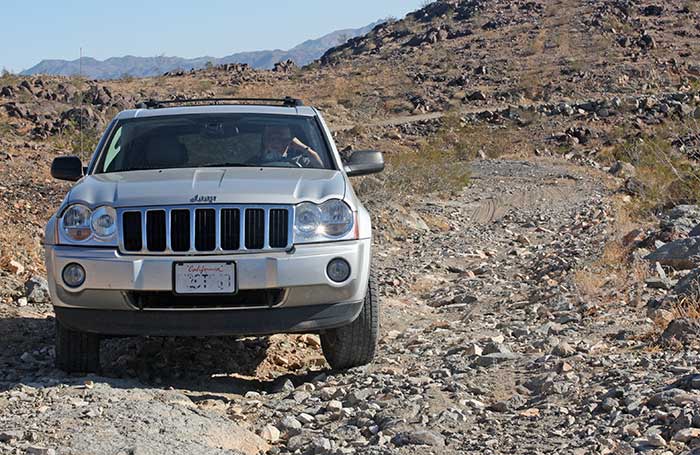
DesertUSA staff members recently embarked on a 4WD expedition into the Pinto Basin byways of Old Dale Route and Gold Crown Road. Former Dale Road starts in Joshua Tree National Park, passes through the Pinto Basin and out of the park into the Pinto Mountains, where it becomes Golden Crown Road. The route ends at California Route 62, 15 miles east of the modest desert town of Twentynine Palms. I was part of the expedition and drove my 4X4. It was my first fourth dimension off-route with it, and I was very pleased with its performance.

Looking back over the route to Pinto Basin
Erstwhile Dale Road can be accessed from Pinto Basin Road, 6.9 miles north of the Cottonwood Visitor Centre, at the aforementioned indicate where the Black Eagle Mine Route begins. All of these roads are marked on the park map, which is distributed gratis at all visitor stations.
Requirements: 4WD required, also an splendid mountain bike trail
Time by Machine: ane.5 to 2 hours
Distance: 23 Miles (ane mode) Not recommended for summertime trips.
Upon our inflow at the entrance to Old Dale Road, we stopped to coordinate our trip and check our cameras. When I exited the jeep, I noticed a big pencil cholla stand (Opuntia ramoissima) nearby and captured some nice shots. This treacherous looking plant with numerous long, sharp spines, is likewise chosen diamond cholla or pencil cactus.

One time organized, we were ready to begin our run a risk down the washboard dirt road into the Pinto Bowl. On both sides of the road, institute life was abundant. I spotted creosote (Larrea tridentata), pencil cholla, numerous fume trees (Dalea spinosa) and an occasional beavertail cactus (Opuntia basilarisouthward). I was surprised to meet and so many plants in bloom in November. In the desert, no matter what month you visit, there is always something in bloom, but the yellow, white and green colors that filled the roadside were more than I had expected.
As nosotros traveled further into the Pinto Basin, the dirt road turned from a washboard graded surface, to sand. Sections of the road passed through sandy washes bordered by smoke copse and desert willows (Chilopsis linearisouth); the latter were in total bloom.
On the right side of the road, as we passed through Pinto Launder, we came upon a landmark sign for Mission Well. The well was drilled in 1934 to provide water to the mines and mills in the nearby surface area. The foundation and other ruins from the well even so remain in adequately expert condition.

Non far from Mission Well, we came upon another abandoned mining expanse which had rusty old containers that may have been used as cyanide vats to split up the gilded from the ore. Crumbled foundations and interesting rocks scattered the surface area. Many of the rocks contained green veins which we were unable to identify.

After Mission Well, we began our ascent into the Pinto Mountains where the Colorado Desert transitions into the Mojave Desert. At this betoken, we were leaving the park and entering BLM country. The road here was treacherous in areas and the slope steep. Rock-filled ravines below the road held old rusted cars and mattress springs, remnants of the Old Dale Mining District.
While climbing the rugged grade, we collection past another erstwhile edifice which was in pretty adept condition. Whoever occupied this particular building, perched high up above the valley, must have enjoyed the breathtaking view of the Pinto Basin below.

Road to Virginia Dale Mine
From here the road leveled out and we encountered another mining ruin where we establish an old dump total of rusty cans and quondam car parts. Merely the foundation and office of a wall remained, just many other interesting items lay scattered almost the area. The vegetation here seemed more feature of the Mojave Desert, and we encountered ratany (Krameria parvifolia), indigo bush (Marina parryi) and Mojave yucca (Yucca schidigera), all in total bloom.

View from Virginia Dale Mine
The dominicus was starting to descend and the town of Twentynine Palms could be seen in the distance. The road was again a hard washboard surface with some sandy stretches.
Nosotros were nearing the cease of our 23-mile journeying, so we made one last finish to have some photos. We discovered a Mojave yucca with a cute white flower blooming from its crest. It was the perfect ending to our off-route trek.
See this story in a Video: Sometime Dale Route/Gold Crown Road
Joshua Tree NP Introductory Package
This parcel includes all of the information yous need to help program your trip to Joshua Tree National Park, from maps, roads and trails to geology, wildlife and points of involvement.

Exploring Black Hawkeye Mine Road
Related Books & Gifts - Trading Mail
4-Bike Trail Driving Tips
Joshua Tree National Park
Twentynine Palms, California
Desert Plants & Wildflowers Alphabetize
Outdoor Recreation: Desert Auto & 4WD Touring
Share this folio on Facebook:
DesertUSA Newsletter -- Nosotros send manufactures on hiking, camping and places to explore, equally well equally animals, wildflower reports, plant information and much more. Sign upwardly below or read more about the DesertUSA newsletter here. (It's Free.)
The Desert Environment
The North American Deserts
Desert Geological Terms
aguilarwastoponcen.blogspot.com
Source: https://www.desertusa.com/desert-trails/old-dale-road-4x4.html
0 Response to "Can You Camp Along Old Dale Road in Joshua Tree National Park"
Post a Comment